Let me be honest with you, because nobody was honest with me.
I love my husband. 26 years, 2 kids, a mortgage we finally paid off. I never stopped loving him.
But somewhere in my early 50s, my body stopped cooperating with that love.
It started small. A flinch I could hide. Then jeans I stopped wearing. Then the long version of getting ready for bed, the "I'll be up in a minute" that bought me time until he was asleep.
I perfected a goodnight kiss that ended the conversation instead of starting one. I slept in an old T-shirt like it was armor. I owned an entire drawer of things the pharmacy aisle sells for this, $18 at a time, and none of them changed anything for longer than an evening. And when he reached for me anyway, I would go somewhere else in my head and wait for it to be over, because the truth was that it hurt. Not metaphorically. Physically. Like something raw that should not be touched.
I never told him that part. He just watched me pull away, year after year, and drew the only conclusion the evidence allowed.
He thought it was him.
I was out of excuses that sounded like tiredness. So when my oldest friend asked me, again, to finally come visit her in Lyon, I said yes. Honestly? I was not going to France. I was leaving my bedroom.
My Friend Is 61. She Had No Idea What I Was Talking About.
Claire and I have known each other for 30 years. She is 61 now, 7 years ahead of me, and within a day of arriving I noticed something I could not name at first.
She was not managing anything.
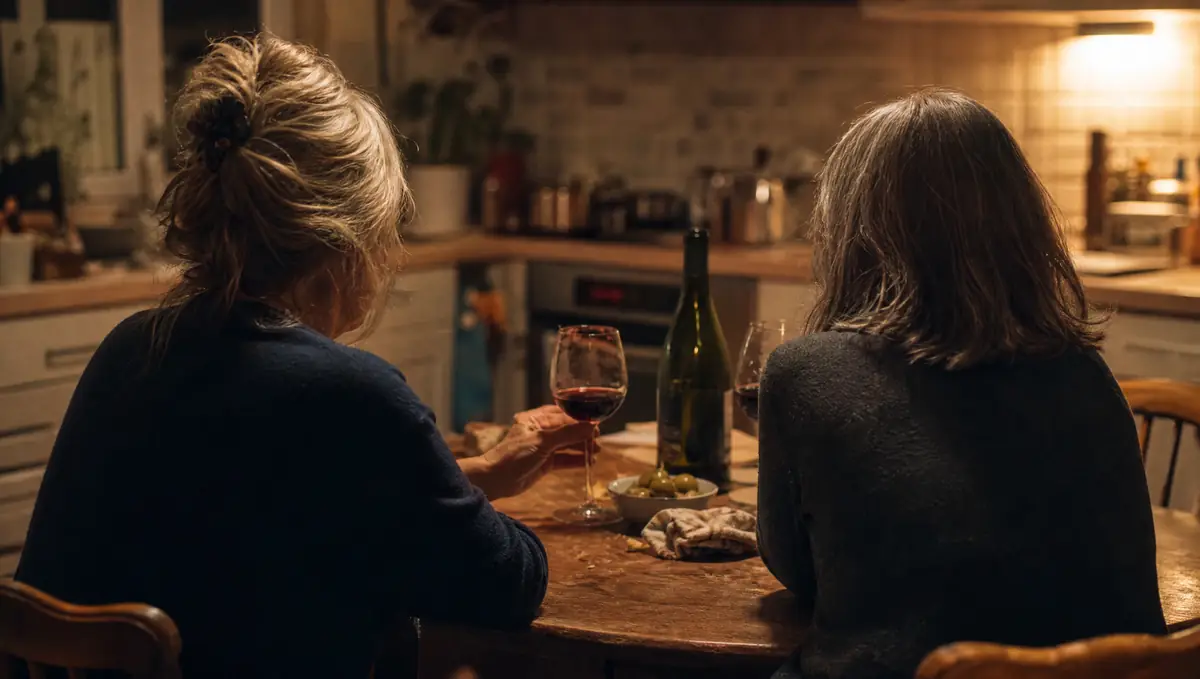
No careful sitting. No strategic wardrobe. When her husband put his hand on her back in the kitchen, she leaned in. It was the leaning in that got me. I could not remember the last time my body let me do that.
On my second night, 2 glasses of wine deep, it came out of me. All of it. The flinching. The armor. The way my husband had started saying "it's fine" in a voice that meant it was not fine. The word I had been terrified of for 2 years: roommates.
I expected sympathy. What I got was confusion.
She said, "But what does your doctor give you for it?"
I laughed. I told her what my doctor gave me. A sample of lubricant and a sentence I will never forget: "This is just part of aging. You'll adjust."
Claire put down her glass. She was quiet for a moment, and then she said something I have thought about every day since:
"The only difference between you and me is what our pharmacies sell."
The Pharmacy Shrug
The next morning she took me to her pharmacy. A small one, green cross over the door, the kind on every French corner.
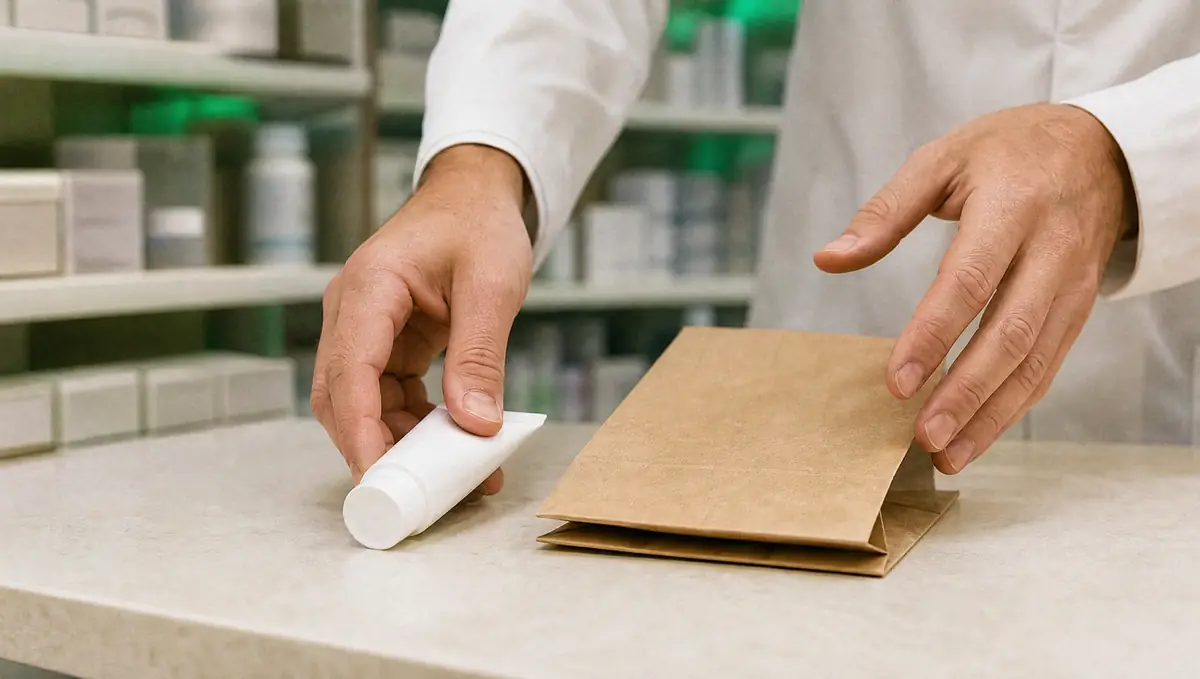
She spoke to the pharmacist for maybe 30 seconds. He nodded the way someone nods about hand soap, reached behind the counter, and bagged a small cream. No lowered voice. No pamphlet about my time of life. A shrug, in the best possible way.
That shrug undid me a little. I had spent 3 years treating this like a shameful secret, and here it was being handled like moisturizer. Because to them, that is what it is. Gentle, local care for skin nobody talks about. Claire has used hers for 9 years. Her mother used it before her. Nobody in her family considers it remarkable, which might be the most remarkable thing about it.
Claire calls it her evening ritual. 90 seconds at the sink, cleanser, face cream, and this. Skincare for the one place American skincare pretends does not exist.
When I got home, I went looking for the same standard of care here. That is how I found the UK doctors behind VIVIA, who had seen exactly what I saw in France and decided American women should not need a passport for it.
Here is the part I have never admitted publicly: I did not tell my husband.
Not because I was ashamed. Because I could not survive getting his hopes up and being wrong again.
So it became my quiet ritual. 90 seconds a night. At first nothing dramatic, just less of an edge. Then one morning I wore the jeans. Then he reached for me in the night, half asleep, the way he had trained himself to stop doing.
I did not move away.
See the 90-day ritual French women swear by →What Came Back Was Not Just Comfort
I want to be careful here, because this is not a story about fireworks. It is a story about a thaw.
It is the hand on my lower back in the kitchen, and leaning in instead of finding a reason to move. It is sleeping in something I actually chose. It is the goodnight kiss going back to being an invitation sometimes, instead of a door closing.
And it is my husband standing differently. I had spent 3 years accidentally teaching this man that his touch was unwelcome, and I watched 3 years of that lift off him in about a month. He laughs more. He reaches for me without that half-second of bracing first.
The desire part surprised me most. I assumed mine was gone for good, some switch that age had flipped. It was not gone. It was buried under the flinch. When the flinch went quiet, it came back on its own, shy at first, like it was checking whether the coast was clear.
Nobody warns you that the pain is never just pain. It rewires the whole marriage around avoiding it. Undo that one thing, and an amount of your life you did not realize you had lost comes back with it.
When I Finally Told Him
About 6 weeks in, I told him everything. France, Claire, the pharmacy, the little cream by the sink he had probably seen 40 times without asking.
He listened to the whole thing and said, "Why would you ever have to hide that?"
And he is right. That is the thing France taught me that I cannot unlearn. There, this is not a confession. It is not a treatment for something broken. It is care, the same category as the cream Claire puts on her face, chosen with the same taste. French women do not whisper about it for the simple reason that there is nothing to whisper about.
I had been treating my own body like a problem to conceal. It just needed what it was no longer getting. There is no drama in that sentence, and it turns out there was never supposed to be.
Why the Drawer of $18 Tubes Never Stood a Chance
Before France, I thought I had tried everything, because I had bought everything.
Lubricants, obviously. The moisturizers that promise 3 days of relief. The "pH balancing" washes. And last year, a berry oil serum I found through an ad that looked a lot like this one, sea buckthorn, beautiful bottle, lovely reviews. I used it faithfully for 2 months.
Here is the pattern I could not see from inside it: every one of those products works ON the skin. None of them works IN it.
A lubricant is an hour of borrowed comfort. A moisturizer is a day of it. The plant oils are the same borrowed hour with a better origin story. And borrowed comfort always comes due, because underneath all of it, the skin itself was quietly changing, and nothing in that drawer was addressing the change. I was moisturizing a canvas that was thinning.
That is why each new product worked a little, briefly, and then did not. It was never the wrong brand. It was the wrong category. The skin was not asking for more moisture on top.
It was asking for the one ingredient it had actually lost. And that ingredient is not oil or water.
What French Women Have Known for 50 Years
Here is what nobody had ever explained to me, in the plain way Dr. Khalid finally did.
The skin in that part of a woman's body is unusually dependent on estrogen. It is what keeps it thick, elastic, cushioned, and able to produce its own moisture. Through my 30s and 40s, estrogen quietly maintained all of that, which is why I never had to think about it.
When estrogen fades in midlife, that maintenance stops. The skin gradually thins. It loses elasticity and its own natural moisture. It becomes fragile in a way that no surface product can reach, which is why it can sting like something raw, and why friction that was once pleasant became something to brace against. Nothing had gone wrong with me. Something had gone missing from my skin.
Estriol is that missing ingredient, in its gentlest form. It is the mildest of the body's own estrogens, applied as a cream, in tiny amounts, exactly where it is needed and nowhere else. Given back what it recognizes, the skin does what skin does: rebuilds its thickness, its cushion, its own moisture, on its own schedule.
This is not a new idea. European women have cared for their skin this way for over 50 years. In France it is simply part of how doctors and pharmacists look after women at midlife, renewed and refilled with a shrug, the way we handle sunscreen. Claire was the 3rd woman in her own family to stand at that counter.
"But Isn't Estrogen Dangerous?" What 2002 Did to American Women
I asked it too. Every American woman does, and it is worth taking seriously, because the fear has a specific birthday.
In 2002, one large American study made headlines linking hormone pills to health risks. Maybe you remember the coverage. Your mother certainly does. What the headlines flattened was what the study actually looked at: strong synthetic hormones, swallowed daily, circulating through the entire body. A completely different substance, taken a completely different way, at a completely different dose.
But the panic did not make distinctions. American medicine retreated from the whole subject almost overnight, and an entire generation absorbed one blunt message: estrogen is dangerous, full stop.
European doctors read the same study. They noted what it did and did not examine, saw that small amounts of gentle estriol applied to one area of skin were a different question entirely, and carried on caring for women the way they had for decades. 3 generations of French women are the result. Not a loophole. Not a fringe theory. The quiet mainstream of an entire continent, running continuously your whole adult life.
And this, finally, answered the question that had bothered me most since that pharmacy: if it is this simple, why did my own doctor hand me a sample of lubricant and a pep talk?
She was not hiding anything. She was trained in the shadow of 2002, in a system that never walked its panic back. Most American doctors get almost no training in this part of midlife medicine, and the safe move inside that system is the sample and the sentence about aging. It was never that the answer did not exist.
It is that I was standing on the wrong continent when I asked.
Discover Intimate Bloom, the 90-day protocol →A 90-Day Ritual, Not a Treatment
VIVIA's Intimate Bloom is that French standard of care, made by doctors, for American women. It is a 90-day protocol: 90 seconds a night at the sink, then twice a week once the skin has what it needs again.
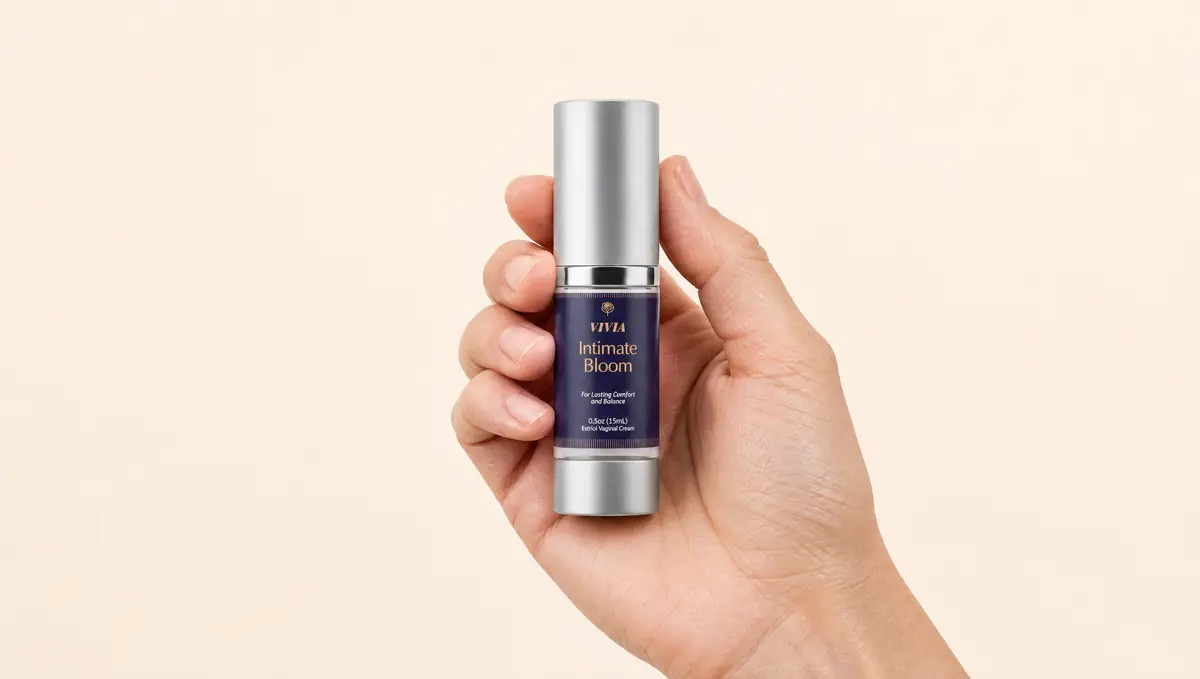
What the 90 days felt like for me: quiet at first, an edge coming off. Then the flinch going silent, the jeans coming back. And then the strange, wonderful part, which is that I stopped thinking about it at all. Which, if you remember Claire, is the entire point.
The full protocol works out to less than $1.70 a day. I had a drawer of $18 tubes that each promised relief and delivered an hour of it. This costs less than that drawer did, and it is the only thing that ever addressed why I needed the drawer in the first place.
A word from the doctor I told this story to:
"As a physician, what stopped me in a French pharmacy was not the cream. It was the shrug. The pharmacist handed it over the way ours hand over lip balm, because for French women this has been ordinary care for 50 years. We did not build VIVIA to medicalise anything. We built it because that shelf should never have required a passport."
Dr. Umair Khalid, MD, with Dr. Arsh, GP
I will leave you with the 2 versions of this coming winter.
In 1, you are still perfecting the goodnight kiss that ends the conversation, still buying the $18 tubes, still letting him believe it is him.
In the other, you gave your body 90 days of what it was quietly asking for, and you are back to leaning in.
The best time to start caring for that skin was years ago. The second best time is this evening.
Begin the 90-Day Ritual →